When a business owner starts the search for a fractional CFO, the focus is usually on the scope of work: reporting, forecasting, strategy. But it’s a mistake not to consider what’s in the contract, because it actually varies quite a bit among firms.
Here’s what’s normal in a fractional CFO contract, and what should make you pause before you sign.
Contract Length and Commitment
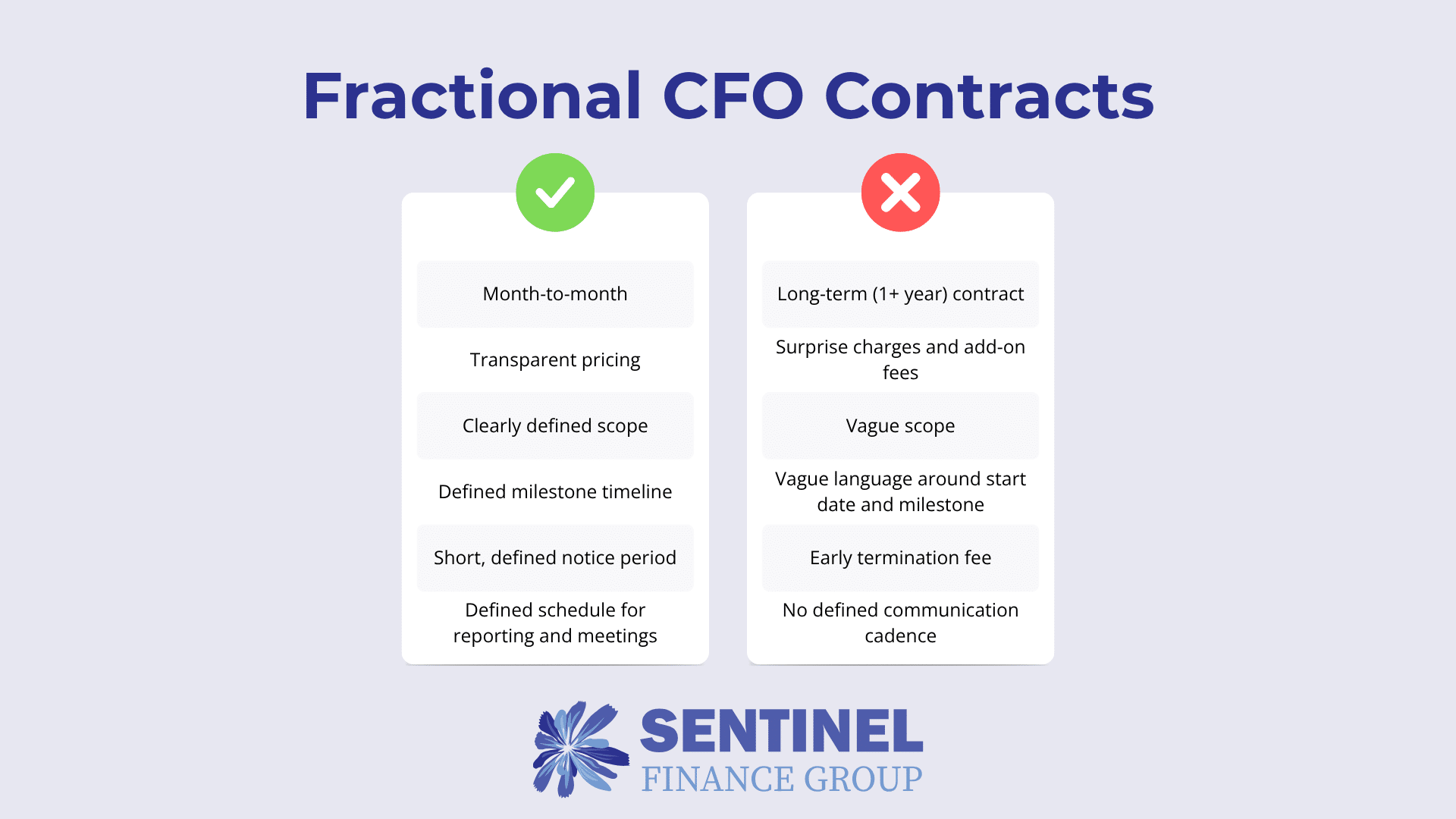
Normal: a month-to-month agreement. A fractional CFO relationship should earn your continued business every month, not lock you in before you’ve seen results.
Red flag: a required one-year or multi-year term with no easy way out. If a firm needs a long-term contract to keep you as a client, that tells you something about how confident they are in the work itself.
Pricing and What’s Included
Normal: a clear monthly fee tied to a defined scope, plus a stated process for anything that falls outside it, whether that’s an hourly rate, a rescoping conversation, or a defined add-on fee. You should know how extra work gets priced before you need it, not find out in the moment.
Red flag: vague pricing language with no specifics, a low base fee that turns out to exclude basic reporting, forecasting, or strategy meetings, or a pattern of surprise charges and add-on fees for things that should reasonably be part of the core service.
Scope of Work
Normal: a written list of what’s included: monthly close, KPI reporting, cash flow forecasting, strategy meetings, and whatever else applies to your business. You should be able to point to the contract and know exactly what you’re getting.
Red flag: scope described only in general terms like “financial guidance” or “CFO support” with no specifics. Vague scope is how firms justify charging extra for things you assumed were already covered.
Where the Work Gets Done
Normal: a firm that’s upfront about whether the work is done in-house, domestically, or overseas, and that gives you a named point of contact you can reach directly.
Red flag: a vague or evasive answer about staffing location. Overseas outsourcing might not automatically be a dealbreaker for you, but it should be disclosed upfront.
Start Date and Milestone Timeline
Normal: a defined start date and a rough timeline for early milestones, like when you’ll see your first close, your first forecast, or your first strategy meeting. You should know what to expect in the first 30, 60, and 90 days.
Red flag: no start date specified, or vague language like “we’ll get started soon” with no milestone timeline attached. Without a timeline, it’s hard to hold a firm accountable.
Notice Period and Exit Terms
Normal: a short, defined notice period (typically 30 days) to end the engagement. You should know exactly what it takes to walk away before you ever need to.
Red flag: an exit clause buried in dense language, an early termination fee, or no exit terms specified at all.
Communication and Meeting Cadence
Normal: a defined schedule for reporting and strategy meetings (usually monthly), specified out in the contract itself. You shouldn’t have to chase your CFO for updates.
Red flag: no defined cadence, or a vague promise of “regular communication.” Again, without a schedule in writing, it’s hard to hold a firm accountable.
Most of what separates a normal fractional CFO contract term from a red flag comes down transparency, clarity, and simplicity. A good firm can tell you what you’re getting, what it costs, who’s doing it, and how to leave, all before you sign anything. If a firm can’t answer those questions plainly, you should ask yourself why.
At Sentinel Finance Group, our contracts include a well-defined scope, no long-term commitment, a 30-day exit, a defined milestone and communication timeline, and our work is always done in-house.
Schedule a conversation with Sentinel Finance Group.
Eric Reinacher is a fractional CFO who brings over a decade of financial leadership experience working with growing companies. He helps business owners improve financial visibility, make better decisions with their numbers, and build businesses that increase in value. LinkedIn
Sentinel Finance Group is a Kansas City-based fractional CFO firm providing financial leadership, controller, and accounting services to $1M-$50M businesses across the US.
FAQ
What should a fractional CFO contract include at minimum?
It should spell out the scope of work, monthly pricing, meeting cadence, notice period to cancel, and a start date with a milestone timeline.
Is a long-term contract normal for fractional CFO services?
No. Month-to-month or short renewing terms are standard. A required one-year or multi-year commitment with no easy exit is a red flag, not an industry norm.
Should pricing be disclosed before the first call?
Yes. Transparent pricing published upfront lets you compare options and know the real cost before you invest time in a sales process.
Is it a red flag if my fractional CFO firm outsources the work overseas?
Not automatically, but it should be disclosed upfront. Ask directly where the work is done and who your point of contact is before you sign, rather than finding out after the fact.
Should I know who my point of contact will be before I sign?
Yes. You should have a named point of contact you can reach directly, regardless of how the rest of the work is staffed or where it’s done.
What’s a normal notice period to end a fractional CFO engagement?
Around 30 days is standard. The exit terms should be clearly written into the contract.
When should I expect to see results after signing?
A defined timeline for early milestones, such as your first close, forecast, or strategy meeting within 30 to 60 days, is standard. If a firm won’t commit to specific milestones, ask why.
What if a firm won’t put deliverables in writing?
Treat that as a warning sign. A firm confident in its process should have no issue documenting exactly what you’ll receive and when.