Revenue can go up while profit goes down, and most business owners don’t notice until they see it in their bank account. Materials cost more. Labor costs more. Insurance, rent, software, and freight all cost more than they did two years ago. This happens gradually, until margin that used to be 20% is now 12% and it’s impossible to point to the exact month it happened.
Protecting margin during a period of high inflation requires multiple moves: knowing your real costs, analyzing pricing, cutting the right expenses, and forecasting with current numbers instead of last year’s assumptions. Here’s how to do each one.
Revenue Growth Can Hide Margin Loss
If sales are up year over year, many business owners assume the business must be healthier than it was last year. That’s not always true. If your cost of goods or cost of service delivery rose faster than your prices, you can grow revenue and lose money on every additional dollar you bring in. Gross margin as a percentage, not revenue in dollars, is the number that tells you whether the business is actually getting stronger.
Know Your Real Cost Structure
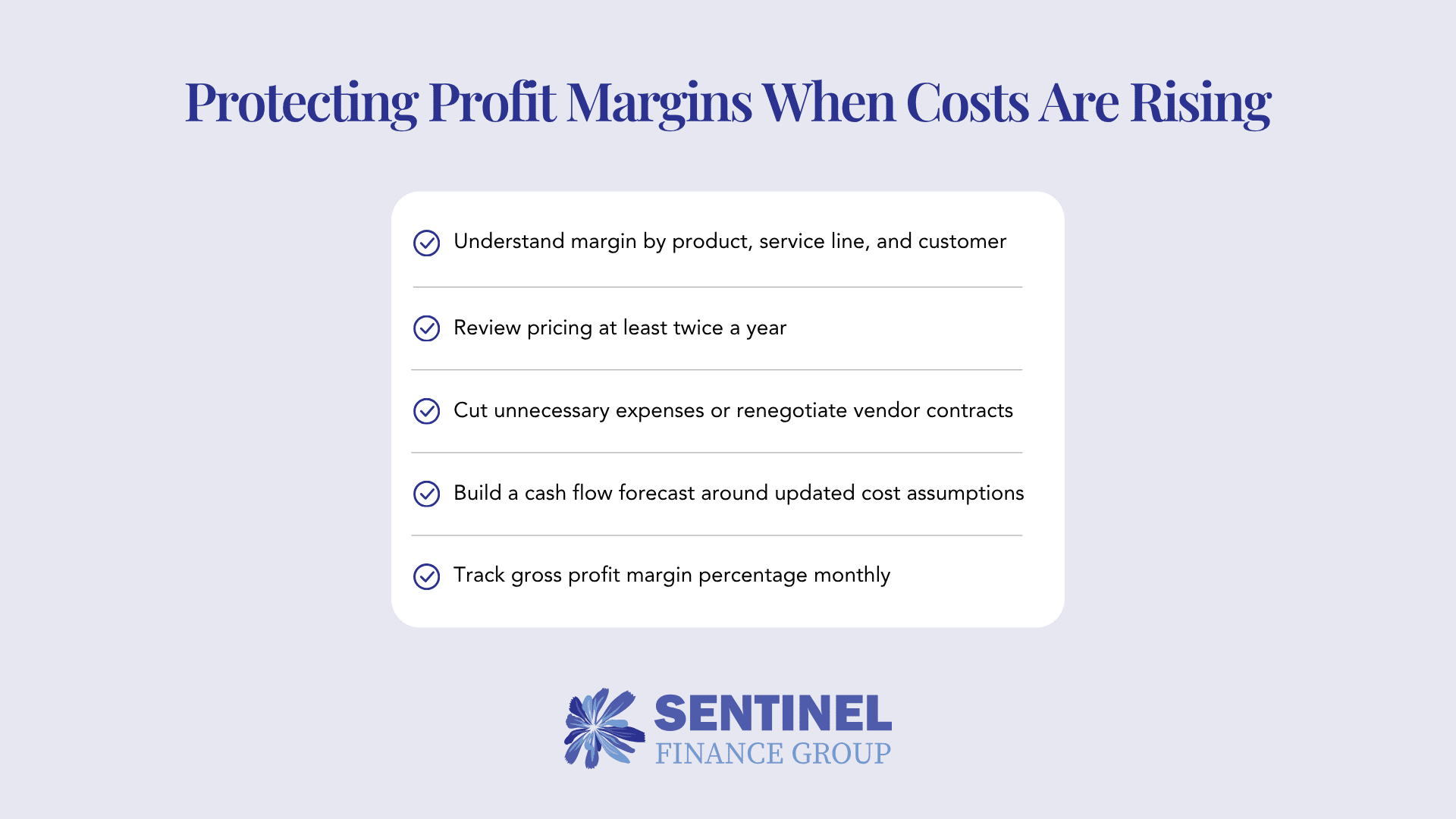
It’s not enough to know total revenue and total expenses. You also need to know the margin on specific products, service lines, and customers. Break your costs into fixed and variable, and track which categories rose the most over the last 12 to 24 months. In our experience, the categories that impact margin the fastest are freight, packaging, subcontractor rates, and software subscriptions.
Revisit Pricing Before You Cut Anything Else
Most business owners raise prices reluctantly. That delay is expensive. Every month you absorb a cost increase instead of passing it through, that margin is gone permanently. Review your pricing at least twice a year during a high-inflation period. A 3-5% adjustment applied consistently protects margin better than one painful 15% catch-up increase after years of absorbed cost creep. Also consider segmenting price increases: some customers and products can absorb an increase without any impact, while others are more price-sensitive.
Cut Costs Without Cutting What Customers Notice
Cost cutting doesn’t have to mean cutting quality or headcount. Start with low hanging fruit: renegotiate vendor contracts, audit software subscriptions for tools nobody uses anymore, and consolidate suppliers where volume gives you leverage. Look hard at any cost that increased automatically through an auto-renewal or a standard annual escalator. Those increases are only negotiated down if someone asks.
Rebuild Your Forecast Around Margin, Not Just Revenue
A forecast built on last year’s cost assumptions will mislead you every time costs are rising. Track gross margin percentage monthly, so a shift shows up immediately. Build your cash flow forecast around updated cost assumptions, and model more than one scenario: what happens if a key input rises another 10%, and what happens if it doesn’t. That gives you a plan before the next cost increase occurs.
___________________________
Margin protection is a habit: know your real costs, price on purpose, cut the expenses that don’t touch the customer experience, and forecast with current numbers instead of old ones. Businesses that build that habit are the ones who get through periods of high inflation with their margins intact.
How a Fractional CFO Helps With Margin Protection
This is the kind of work we do with clients every month:
Margin visibility by product and customer. Provides a clear read on which parts of the business are actually profitable.
Pricing analysis. A structured look at where a price increase will be effective, based on your actual numbers.
A cash flow forecast that adjusts with your costs. Updated monthly, so you see a margin problem coming in advance.
One team that stays close to the numbers. The same people reviewing your books every month are the ones flagging decreasing margins.
Schedule a conversation with Sentinel Finance Group.
Eric Reinacher is a fractional CFO who brings over a decade of financial leadership experience working with growing companies. He helps business owners improve financial visibility, make better decisions with their numbers, and build businesses that increase in value. LinkedIn
Sentinel Finance Group is a Kansas City-based fractional CFO firm providing financial leadership, controller, and accounting services to $1M-$50M businesses across the US.
FAQ
Why are my profit margins shrinking even though sales are increasing?
Your cost of goods or cost of service delivery is likely rising faster than your prices. Revenue growth can mask margin loss because it shows up in dollars, not percentages, so track gross margin percentage, not just total revenue, to see the real trend.
How often should I review pricing during a period of high inflation?
At least twice a year, and ideally quarterly if your input costs are volatile. Waiting a full year to adjust prices means absorbing months of cost increases you’ll never recover.
What expenses should I cut first when costs are rising?
Start with costs the customer never sees: vendor contracts that haven’t been renegotiated in years, unused software subscriptions, and auto-renewed services with built-in annual increases. Those cuts protect margin without touching the customer experience.
How do I know if a price increase will hurt customer retention?
Segment your customers and products before deciding. Some can absorb a price increase without any impact on retention, others are more price-sensitive, and a targeted increase usually performs better than one blanket change across the board.
What’s the difference between gross margin and net margin?
Gross margin is revenue minus the direct cost of producing your product or delivering your service. Net margin subtracts everything else, including overhead, so a business can have healthy gross margin and still lose money if overhead is too high.
Can I protect my margins without raising prices?
Yes, to a point. Renegotiating vendor contracts, cutting unused expenses, and improving operational efficiency all help, but if your costs have risen significantly, cost cutting alone usually isn’t enough to fully offset it.
How does a fractional CFO help with margin management?
A fractional CFO tracks margin by product, service line, or customer, builds a forecast around your actual current costs, and identifies where pricing or cost changes will make the biggest difference. That level of visibility is hard to get from a monthly bookkeeping report alone.
How do I know which of my costs are actually essential?
Look at whether a cost drives revenue, protects quality, or is required to operate, versus a cost that continues out of habit or an auto-renewal nobody reviewed. A cost review at least once a year catches expenses that no longer earn their place in the budget.