
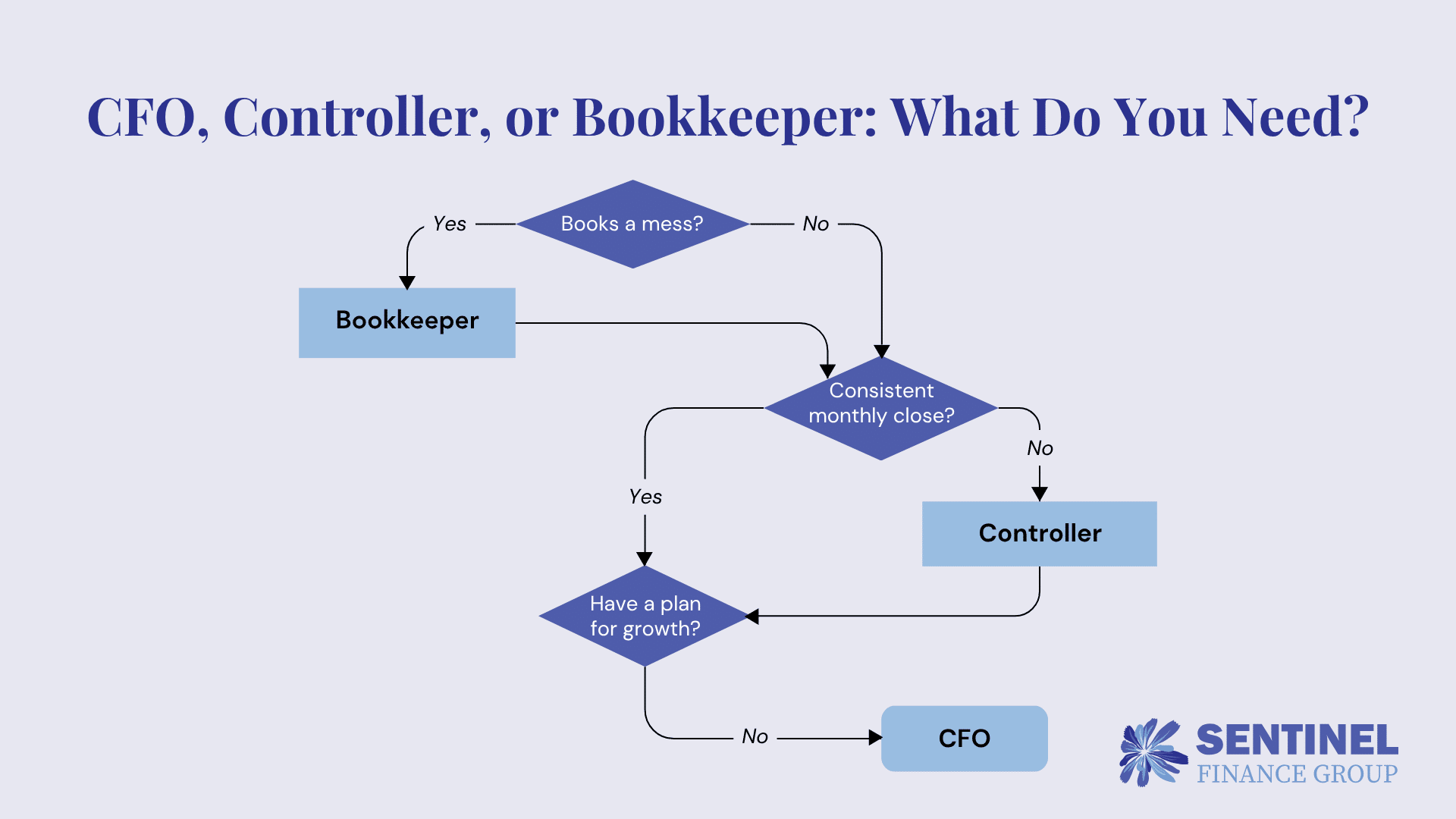
If you’re trying to figure out whether you need a bookkeeper, a controller, or a CFO, you’re not alone. It’s not common knowledge. But not knowing the difference leads to a common and expensive mistake: hiring the wrong one. You end up paying CFO rates for work that’s really bookkeeping, or you hire a bookkeeper and expect controller-level output.
The simplest way to think about it: a bookkeeper records what happened, a controller makes sure the numbers are right, and a CFO helps you decide what to do next. All three are valuable as a business grows. The right mix depends on where your company is today and what you actually need from your financial team.
The Bookkeeper’s Job
A bookkeeper handles the day-to-day financial transactions of the business. That means recording transactions, categorizing expenses, reconciling bank and credit card accounts, managing accounts payable and receivable, and keeping the general ledger up to date. The bookkeeper should make sure the financial records reflect what actually happened in the business.
A good bookkeeper gives you clean, organized books. But clean books don’t tell you what you should do with the information. That’s where the next level comes in.
The Controller’s Job
A controller is responsible for the accuracy and integrity of the company’s financial reporting. While a bookkeeper focuses on recording transactions, a controller looks at the financial system as a whole, including the monthly close, financial statement preparation, account reconciliations, accounting policies and procedures, internal controls, cash and working capital reporting, year-end preparation, and oversight of the accounting team. They may assist the CFO with budgeting, forecasting, and cash flow planning.
The controller’s job is making sure the numbers are accurate, complete, and produced consistently. This matters more as a company grows. More transactions, more employees, more locations, and more complexity all make it harder to know whether the financial statements tell the right story. A controller makes sure they do.
The CFO’s Job
A CFO takes the financial information and interprets it to help the business make better decisions. A CFO looks forward, not just backward. A CFO is responsible for budgeting and forecasting, cash flow planning, financial modeling, gross profit analysis, pricing and margin analysis, evaluating growth opportunities, capital planning, M&A support, business valuation, and identifying financial risk.
A CFO looks at whether you can afford to hire, what happens to your liquidity if you grow 30%, which revenue lines are actually profitable, whether you should raise prices, when a new location will start making money, and where you should invest your next dollar. Those questions require more than accurate accounting. They require someone who understands how the financial pieces connect to the rest of the business.
Matching the Role to What You Need
What you need depends on where you are.
If your books are a mess, accounts aren’t being reconciled, or you’re behind on AR/AP, you need bookkeeping fixed first. Budgeting and forecasting can wait until the foundation is clean.
If your books are technically accurate but your monthly financials aren’t reliable, your close takes too long, or no one is overseeing the accounting function, you need controller-level support.
If your books are clean, your close is on time, and what you’re missing is a plan for growth, pricing, cash flow, or profitability, you need CFO support.
When a Business Needs CFO-Level Support
There’s no magic revenue number where a company suddenly needs a CFO. The better question is whether the financial decisions you’re making have become too important or too complicated to manage without financial leadership.
Some signs: revenue is growing quickly, cash flow is becoming harder to predict, margins are decreasing, you’re considering hiring, expansion, or an acquisition, you don’t know which products, customers, or business lines are actually profitable, your financial reports tell you what happened but not why, you’re making major decisions without financial analysis, or your accounting team is busy producing reports that no one is using to drive decisions.
At that point, adding another person to enter transactions probably isn’t the answer. You need someone who can step back and look at the business as a whole.
Working With Your Existing Team – What if I Already Have A Bookkeeper or Controller?
If you already have a bookkeeper or controller, a CFO doesn’t replace them. In most cases, the CFO works with the bookkeeper and controller you already have. The bookkeeper keeps the transactions moving. The controller makes sure the accounting and reporting are accurate. The CFO takes that information and turns it into financial insight leadership can actually use. That combination is far more effective than expecting one person to do all three jobs.
Why the Difference Matters
The biggest mistake is assuming that having someone handle the books means you have financial management covered. You can have perfectly clean financial statements and still have no idea where your business is headed. Accounting tells you what happened. Financial leadership helps you understand why it happened, what it means, and what to do about it. That’s the real difference between bookkeeping, controllership, and CFO work.
Many growing businesses actually need a blend of all three, without the payroll cost of three full-time hires. That’s exactly why we built Sentinel Finance Group. We already know what good bookkeeping, controller, and CFO work looks like, so we can look at your business and tell you exactly which level(s) you need right now. You get the expertise across all three roles without the burden of hiring, training, or managing three separate people, and you’re never paying CFO rates for work that’s really bookkeeping.
Schedule a conversation with Sentinel Finance Group.
Eric Reinacher is a fractional CFO who brings over a decade of financial leadership experience working with growing companies. He helps business owners improve financial visibility, make better decisions with their numbers, and build businesses that increase in value. LinkedIn
Sentinel Finance Group is a Kansas City-based fractional CFO firm providing financial leadership, controller, and accounting services to $1M-$50M businesses across the US.
FAQ
What’s the difference between a bookkeeper, a controller, and a CFO?
A bookkeeper records transactions and keeps the books clean. A controller makes sure the books are right and manages the close, budgeting, and forecasting. A CFO decides what to do with that information: strategy, growth planning, and major financial decisions.
Can one person be a bookkeeper, controller, and CFO?
Typically, one person doesn’t have the knowledge to fulfill all three (and if they do, you’ll be paying CFO rates for bookkeeping work).
Do I need a CFO if I already have a good bookkeeper?
If you’re doing $1M or more in revenue and can’t get clear answers from your numbers, you likely need CFO-level insight. A good bookkeeper is critical for maintaining accurate financial records, but bookkeeping doesn’t provide the same level of financial analysis, forecasting, and strategic decision-making as a CFO.
Do I need a CFO if I have a controller?
It depends on what the business needs. A controller provides strong accounting and financial reporting. A CFO adds forward-looking analysis, planning, and strategic financial leadership.
What does a fractional CFO do?
A fractional CFO provides CFO-level financial leadership without the cost of hiring a full-time CFO. Depending on the business, that can include financial reporting, budgeting and forecasting, cash flow analysis, profitability analysis, financial modeling, M&A support, and strategic decision support.
When should a small business hire a CFO?
Fractional CFOs typically work with businesses generating between $1M and $50M in annual revenue, though the decision to hire a fractional CFO depends more on complexity than revenue alone. A business may need CFO-level support when financial decisions are becoming more complex, cash flow is harder to manage, growth requires significant investment, or leadership needs more than historical financial reports to make decisions.
Can one firm provide bookkeeping, controller, and CFO-level support?
Yes. Most growing businesses need a blend of all 3 roles. Sentinel Finance Group can cover all three levels under one team instead of three separate hires.


