Every company should have an annual budgeting process. A budget sets your company’s financial goals for the year ahead, and it should be used all year long to measure how you’re actually performing against those goals.
Most companies build the next year’s budget the same way: pull historical averages, adjust them by a percentage, and call it done. That approach works for a first draft, but it’s not enough on its own to get your company to its growth potential in 2027. Here’s how to build a budget that works as a growth plan.
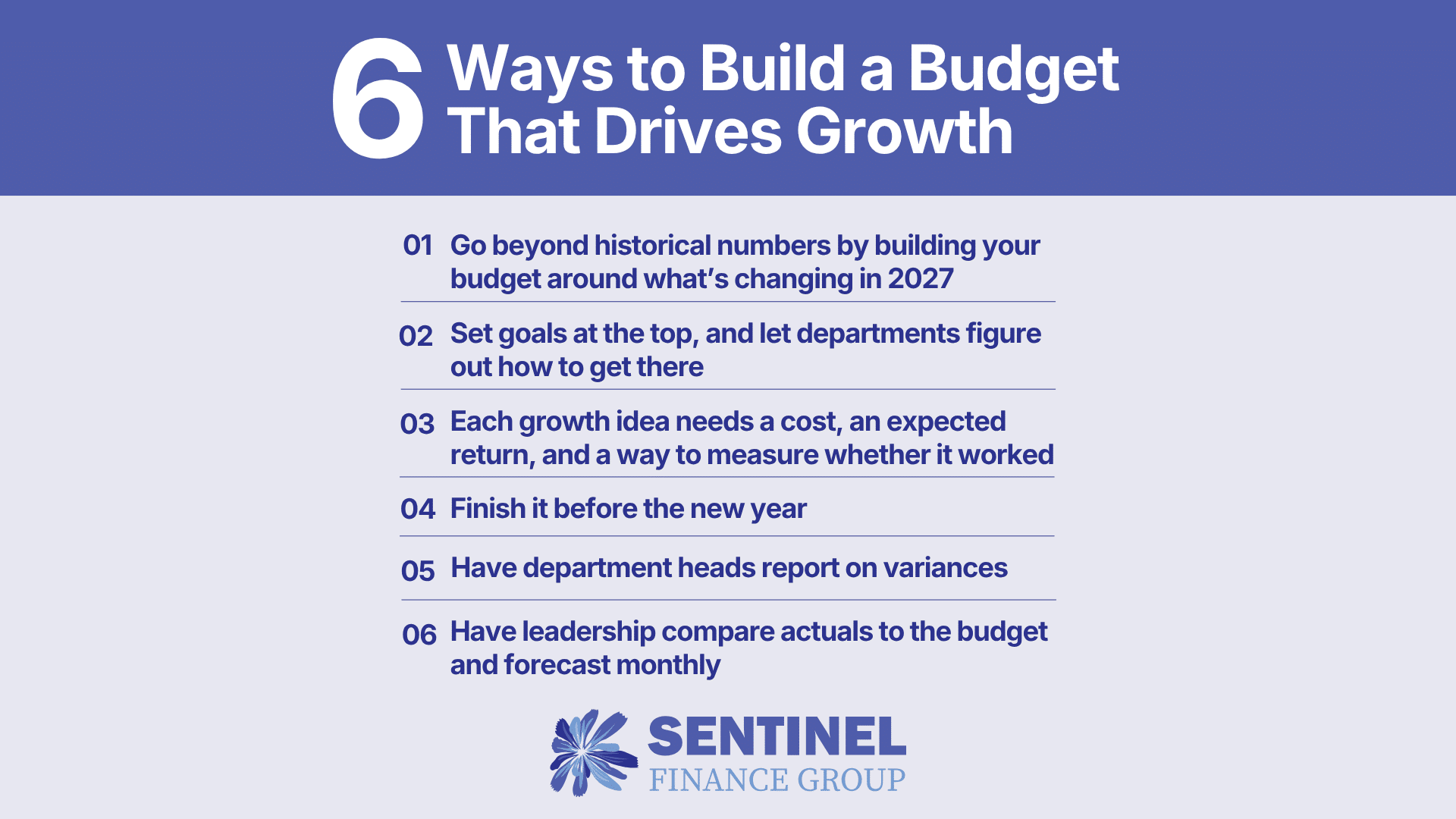
1. You Can Start With Historical Numbers, but Don’t Stop There
Looking to your accountant for historical averages and adjusting them by a percentage is a reasonable starting point for a budget. Historical numbers tell you what happened, but they don’t tell you what’s changing in 2027. A budget built only on last year’s numbers plus a percentage increase misses a new hire, a new product, or a market you’re planning to enter.
2. Set Goals at the Top, Then Get Input From Every Department
Setting overall company financial goals is the executive team’s job. Figuring out how to hit those goals belongs to the departments responsible for the numbers, and they should have real input into how the budget is built. Marketing, sales, operations, and HR each know what’s coming: projects and expenses already in the pipeline, plans to expand into new markets, and personnel changes. That information belongs in the budget before it’s finalized.
Don’t just ask departments what’s coming. Ask them what they would do to help the company hit its goals. Sales may see an untapped customer segment. Operations may know which process change would free up capacity. Marketing may have a promising channel they’d test with the right budget. The people closest to the work usually have the best ideas for growing it, and the budget process is the right time to bring those ideas out. Departments that help build the budget are also more invested in hitting it.
3. Make Departments Build the Case for Growth Investments
Every growth idea should come with a cost, an expected return, and a way to measure whether it worked. A new sales hire should be tied to a revenue target. A marketing increase should be tied to pipeline. When departments build the case themselves, leadership can compare ideas side by side and fund the ones with the strongest return, instead of spreading increases evenly across the company.
Not every investment has to be approved all at once. Some growth spending can be tied to milestones: if first-quarter revenue beats the plan, for example, funding for a second sales hire is released. That lets you plan for growth responsibly, without betting everything on assumptions you made in December.
4. Build Accountability Into the Process From Day One
A budget only works if someone checks it against reality. Departments should review their actuals against budget numbers at least monthly, and provide explanations and corrections for any discrepancies. Without regular review, a budget becomes obsolete by February.
Monthly reviews aren’t only about catching overspending. They also show what’s working. If a new channel or hire is beating expectations, you’ll know early enough to put more money behind it mid-year instead of waiting for next year’s budget.
5. Finish the Budget Before the New Year Starts
A 2027 budget finished in February helps you much less than one finished in December. The budget needs to be complete before the new year begins so it can be imported into your accounting system and included in your forecasts and your monthly or quarterly reporting from day one. Waiting until the new year is already underway means running the first weeks or months without your main planning tool in place.
6. Connect the Budget to Your Forecast and Monthly Reporting
A budget that sits by itself in a spreadsheet has no value. It should show up every month in the reporting your leadership team reviews, next to two other sets of numbers: your actuals and your forecast.
The budget is the plan you set before the year starts, and it stays fixed. A forecast is a rolling projection that gets updated every month based on actual results and anything that’s changed since the budget was set, like a large new customer, a delayed hire, or a cost increase.
Actuals tell you where you are. The budget tells you where you planned to be. The forecast tells you where you’re likely to finish the year. Looking at all three together is how you catch a variance while you can still do something about it, and how you spot when you’re ahead of plan and can afford to invest sooner.
How Sentinel Finance Group Helps With Budgeting
Sentinel Finance Group guides clients through the whole budget process. We work with the executive team to set company-level financial goals. Then we lead the department conversations that turn those goals into a working plan: what each team needs to hit its numbers, which growth ideas they want to pursue, what’s already in the pipeline, and where the tradeoffs are. We help departments develop and test their growth proposals, modeling the expected return before anything goes into the budget. We also coach department leaders on how to work within a budget once it’s set.
Once the year starts, we put budget and forecast data directly into monthly financial reporting, update the forecast as results come in, and track variances every month. When actuals drift from the plan, leadership knows why and still has time to adjust, whether that means pulling back or putting more behind what’s working.
A budget built this way is one your whole team uses all year to drive growth.
Schedule a conversation with Sentinel Finance Group.
Eric Reinacher is a fractional CFO who brings over a decade of financial leadership experience working with growing companies. He helps business owners improve financial visibility, make better decisions with their numbers, and build businesses that increase in value. LinkedIn
Sentinel Finance Group is a Kansas City-based fractional CFO firm providing financial leadership, controller, and accounting services to $1M-$50M businesses across the US.
FAQ
When should a company start its budget for the next year?
Most companies should start the budgeting process in the fall, at least two to three months before year-end, so the budget is finished and ready to load into the accounting system before January 1.
Who should be involved in building a company budget?
The executive team and the leaders of every department with budget responsibility. Executives set the overall financial goals, and department leaders provide input on the specific projects, expenses, and plans that will drive those numbers.
How can a budget help a company grow?
By turning growth ideas into funded plans. When departments propose specific growth investments, each with a cost, an expected return, and a way to measure results, leadership can fund the strongest ideas. Monthly reviews then show which investments are paying off, so the company can put more money behind them during the year.
What’s the difference between a budget and a forecast?
A budget is the financial plan set once, before the year begins, and it stays fixed. A forecast is a rolling projection, updated monthly based on actual results, that shows where the year is likely to end up. Both should be reviewed together, alongside actuals, throughout the year.
How often should actuals be compared to the budget?
Monthly, at minimum. Reviewing actuals against budget every month is what lets a business catch and correct a variance early instead of discovering it months later.
What happens if a company budgets using only historical averages?
It misses anything that’s changing: new hires, new markets, new projects, or pipeline shifts that haven’t shown up in past numbers yet. Historical averages are a useful starting point, not a complete budget on their own.
Why does a budget need to be finished before the new year starts?
So it can be imported into the accounting system and included in forecasts and monthly or quarterly financial reporting from the first month of the year, rather than being added partway through.
Can a fractional CFO help with the budgeting process?
Yes. A fractional CFO can guide the budget process, facilitate the conversations between departments and leadership, help departments build and evaluate growth proposals, and build reporting that tracks actuals against the budget and forecast throughout the year.