What a Fractional CFO Sees That Most Owners Miss
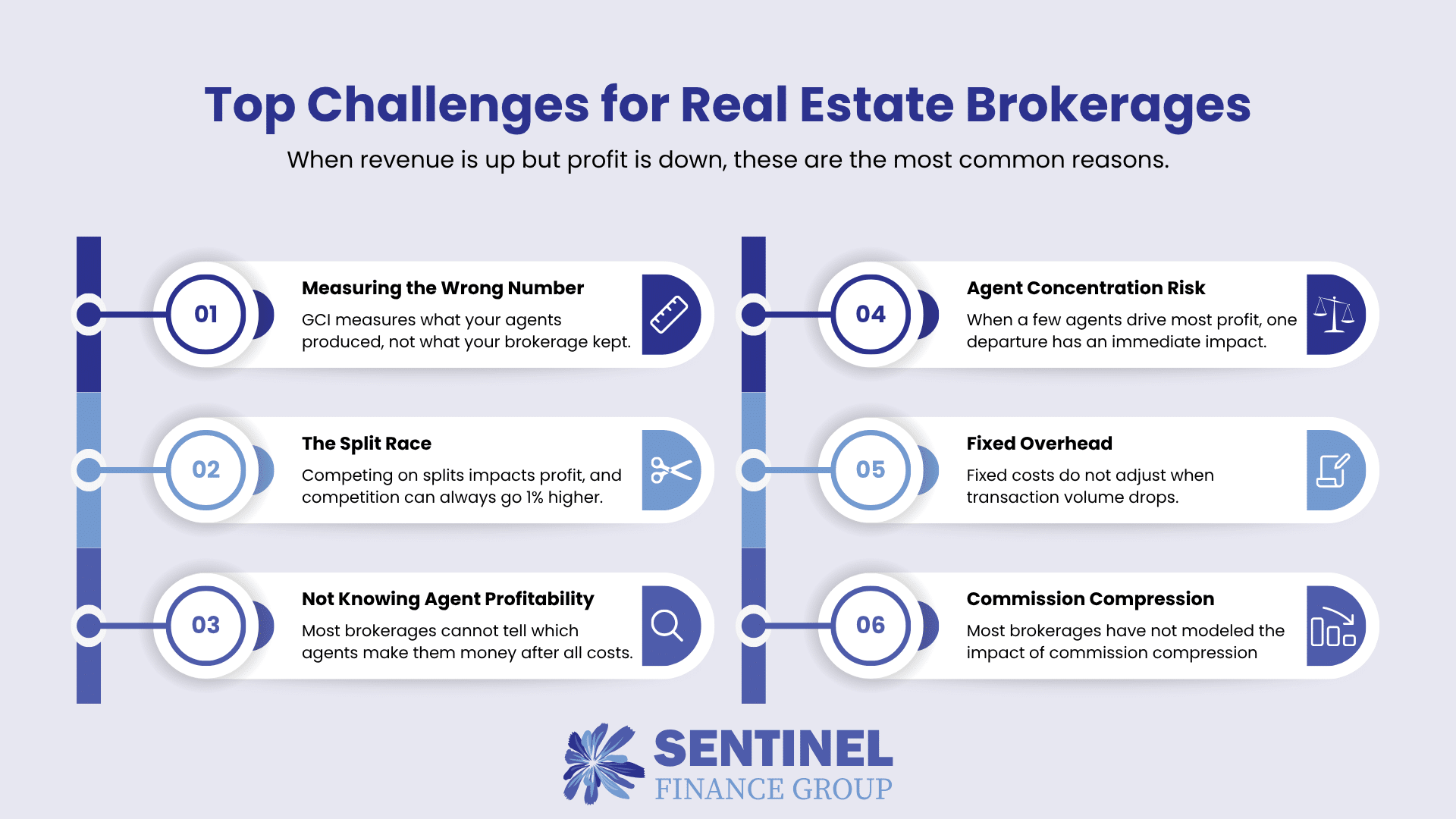
The biggest financial challenges for real estate brokerages in 2026 are: running the business off GCI instead of Company Dollar, a split structure race that is decreasing margins, not knowing which agents are actually profitable after all costs, agent concentration risk, fixed overhead that does not decrease when volume drops, and commission compression that is here to stay after the 2024 NAR settlement.
“We’re doing great—our GCI is up 25 percent!” That is how a financial review started with one of my new brokerage clients. After digging into the numbers, the picture looked different. Company Dollar was down. Profit was down. GCI and profitability were moving in opposite directions, and nobody could pinpoint why.
Here are the six financial problems behind it.
Why 2026 Is a Pivotal Year for Brokerage Finances
The 2024 NAR settlement changed how buyer agent compensation is disclosed, negotiated, and paid. Commission rates that were previously treated as standard are now actively negotiated on every transaction. Brokerages that built their financial models around historical commission levels are already feeling the effect.
At the same time, competition for top-producing agents has pushed split structures to levels that look attractive on a recruiting sheet but create real margin problems at the brokerage level. The brokerages managing through this environment are the ones watching the right numbers.
The Top Financial Challenges for Real Estate Brokerages in 2026
1. GCI Is the Wrong Number to Run a Brokerage Around
The problem: Most real estate brokerages run their business off gross commission income—total commission revenue before splits. GCI measures what your agents produced. It does not measure what your brokerage kept. After commission splits, the Company Dollar a brokerage retains often falls to 15 percent of GCI or less. That is what is left for overhead, staff, and profit. GCI and Company Dollar are two different things. Focusing on one without the other is how a 25 percent revenue gain can actually be a profit problem.
What a fractional CFO does: Builds a model based on Company Dollar that separates agent economics from brokerage economics, tracks the margin the business earns on each transaction, and gives ownership a clear view of brokerage profitability rather than agent production.
2. The Split Race Is a Losing Game
The problem: Brokerages are undercutting each other on splits to attract top producers, and many are giving away 80 to 90 percent or more. That is how a brokerage can be growing GCI and losing money at the same time. The math on recruiting is rarely modeled: what does it cost to bring on an agent, what production does it take to break even on that cost, and how long does it take to get there? Most brokerage owners cannot answer those questions. And most are not asking what else (besides a higher split) would actually make a top agent stay.
What a fractional CFO does: Increasing your splits is decreasing your profits, and it is a losing game when a competitor can always go further. My clients often talk about how they cannot compete with online brokerages that have substantially less overhead. We work through the full economics of a split decision, then identify what else the brokerage can offer to attract productive agents without giving away more margin: administrative support, leads, culture, community, technology, training, and tools.
3. Most Brokerages Do Not Know Which Agents Are Actually Profitable
The problem: Brokerage owners know who closes the most deals. Most do not know which agents are profitable to the brokerage after accounting for splits, desk costs, technology, administrative time, insurance, and any leads or marketing provided. Every agent comes with costs beyond the split. Some high-volume agents require so much overhead support that their net contribution to Company Dollar is actually small. Other more independent producers cost very little to support and drive significant margin. Without looking at the numbers by agent and by transaction, you cannot tell which is which.
What a fractional CFO does: In our monthly reporting, we review metrics including cost per transaction, average revenue per transaction (ARPT), and Company Dollar per agent to stay on top of agent profitability. The first time I run a true profitability analysis for a brokerage, owners are often surprised to see how many of their agents are actually costing them money. The goal is not to cut agents –it’s to understand which relationships are working and which need to be structured differently, whether that is the split, the support, or the production expectations. The same analysis shows you exactly what your best performers look like to inform recruiting.
4. Agent Concentration Is a Financial Risk
The problem: In most brokerages, once you run the real numbers, a small number of agents drive a disproportionate share of Company Dollar. If the top three agents represent 80 percent of brokerage profit, the business is exposed in ways that do not show up on a typical financial report. If one leaves, takes a team, or has a down year, the financial impact is immediate and hard to absorb.
What a fractional CFO does: What most owners do not realize is that this is not just an operational risk—it is also a valuation risk. Revenue concentration is one of the primary factors buyers and acquirers discount when pricing a business. My goal with brokerage clients is not just to improve profitability today but to build a business that increases in value. That means quantifying agent concentration risk, modeling the financial impact of losing key producers, and working with owners on a plan to diversify, develop, or recruit around it.
5. Fixed Overhead Does Not Match Variable Revenue
The problem: Office space, staff, technology, and marketing do not adjust when transaction volume drops. In a slow quarter, the costs stay constant while revenue contracts. Most brokerages cannot clearly define their break-even transaction volume at current overhead levels, or what the business looks like if production drops 20 to 30 percent. They find out when it happens.
What a fractional CFO does: We build a model that shows you in advance what the business looks like across a range of production scenarios, so you can make overhead decisions before you are forced to. That means defining the fixed versus variable cost structure and calculating break-even at different transaction volumes.
6. Commission Compression Is Here to Stay
The problem: Buyers and sellers now have more visibility into what commissions are being paid and more negotiating room, especially since the 2024 NAR settlement. Brokerages that built their financial plans around historical commission rates need to understand what happens to Company Dollar if rates compress by 10, 20, or 30 percent. Most have not modeled it.
What a fractional CFO does: We build a commission compression model across your current transaction mix so you can see the impact on Company Dollar before it shows up in your bank account. That means stress-testing the business against realistic commission scenarios—not just current rates—and building a financial plan that holds up under real pressure.
Why Real Estate Brokerages Work With Sentinel Finance Group
We work specifically with real estate brokerages, investors, and developers.
The difference our clients describe is what happens after the analysis. We translate the numbers into operational decisions and help execute on them. We do not hand over a report and leave the room. Clients have described us as quickly becoming irreplaceable, bringing clarity to both past performance and forward planning, and presenting complex information in a way that is immediately useful for running the business.
Frequently Asked Questions
What does a fractional CFO do for a real estate brokerage?
A fractional CFO for a real estate brokerage builds financial models around Company Dollar rather than GCI, runs profitability analysis by agent and by transaction, quantifies agent concentration risk, calculates break-even transaction volumes, and stress-tests the business against commission compression and volume decline scenarios. The role goes beyond reporting—it includes helping ownership translate the numbers into operational decisions about recruiting, overhead, splits, and growth, and helping execute on them.
What is Company Dollar in real estate?
Company Dollar is the revenue a brokerage retains after paying agent splits and direct transaction costs. It is the number that covers office overhead, staff, marketing, and profit. After commission splits, Company Dollar often falls to 15 percent or less of GCI. It is the most important financial metric for a brokerage and the one most often tracked as an afterthought.
How do you measure agent profitability at a real estate brokerage?
True agent profitability requires looking beyond transaction volume to what each agent actually contributes to Company Dollar after splits, and what it costs the brokerage to support them. The key metrics are cost per transaction, average revenue per transaction (ARPT), and Company Dollar per agent. A high-volume agent who requires significant lead generation support, administrative time, and technology overhead may be less profitable than an independent producer who closes fewer deals at lower cost.
When should a real estate brokerage hire a fractional CFO?
When GCI is growing but profit is not. When split and recruiting decisions are being made without financial modeling. When you cannot identify which agents are actually profitable after all costs. When you do not know your break-even transaction volume. Any of these is a sign the business has grown faster than the financial infrastructure supporting it.
How does the NAR settlement affect brokerage profitability in 2026?
The 2024 NAR settlement eliminated the requirement for sellers to offer buyer-side compensation through the MLS. Buyer agent commission rates are now actively negotiated on individual transactions rather than treated as near-standard. For brokerages, commission compression scenarios that were previously theoretical are showing up in real deals. Brokerages that have not modeled the impact on Company Dollar are operating on assumptions that may no longer hold.
What is a healthy Company Dollar percentage for a real estate brokerage?
Company Dollar as a percentage of GCI varies by business model. Traditional brokerages typically retain 15 to 30 percent of GCI as Company Dollar before overhead. High-split and 100-percent commission models trade Company Dollar percentage for volume and desk fee revenue. The more important question is whether Company Dollar covers fixed overhead and produces a profit at current and projected transaction volume.
What This Looks Like in Practice
If you recognize any of the problems above, we are happy to talk through what the numbers actually look like for your brokerage.
Schedule a conversation with Sentinel Finance Group.
Want a starting point before we talk? Download the free pocket guide for real estate operators: Top Financial Mistakes Real Estate Companies Make — and How to Fix Them
More on our real estate CFO services: https://re.sentinelfinancegroup.com/.
Eric Reinacher is a fractional CFO who brings over a decade of financial leadership experience working with real estate companies. He helps business owners improve financial visibility, make better decisions with their numbers, and build businesses that increase in value.
LinkedIn
Sentinel Finance Group is a Kansas City-based fractional CFO and controller firm serving growing businesses across the US.