
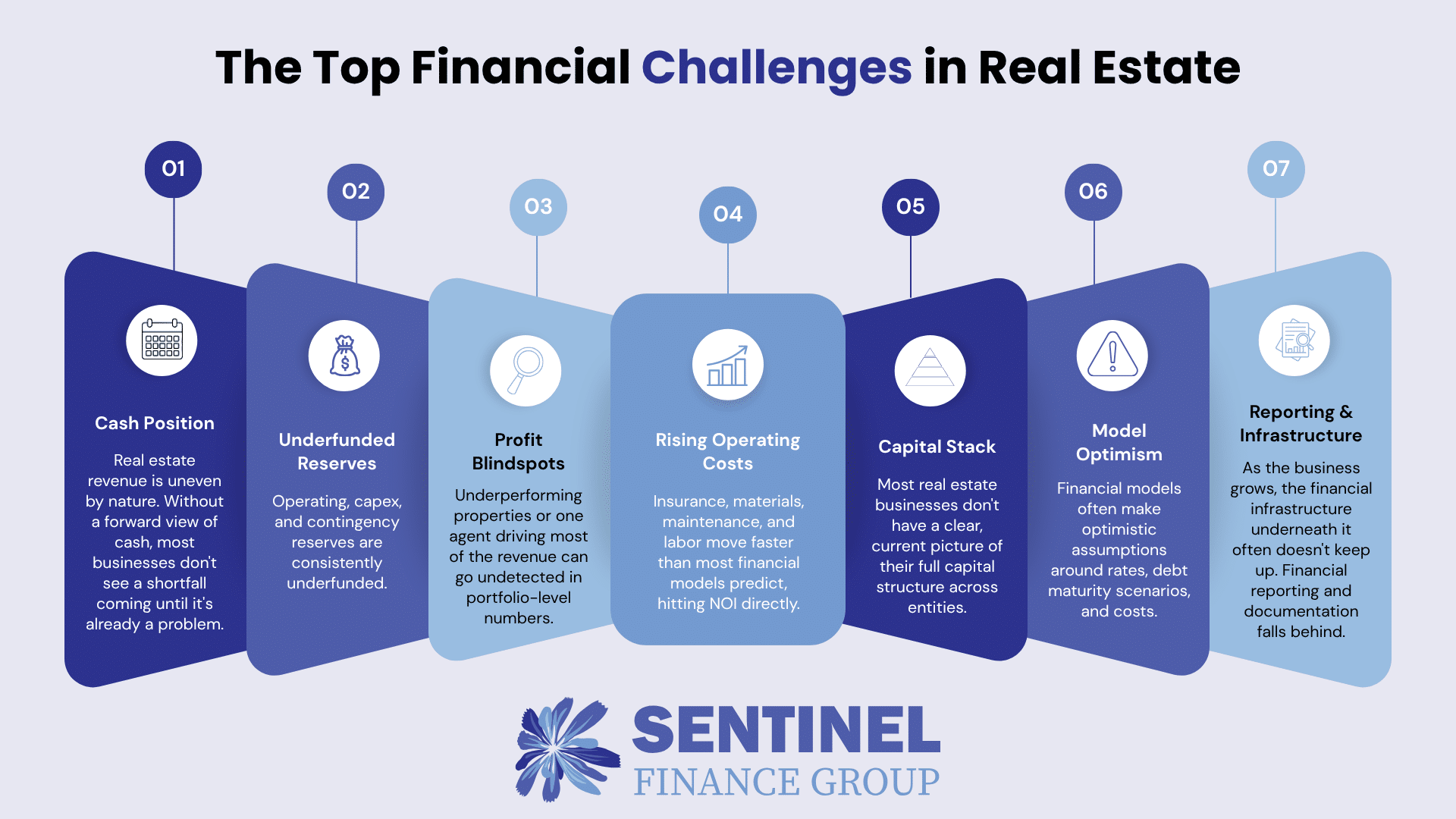
Sentinel Finance Group provides fractional CFO and controller services to real estate companies, including investment portfolios, property maintenance companies, development companies, and residential and commercial brokerages. A fractional CFO provides the financial leadership of a full-time CFO on a part-time or project basis, at a fraction of the cost.
Real estate businesses operate in one of the most financially complex environments of any industry. Managing capital across properties, investors, and deal cycles requires more than bookkeeping. It requires financial systems, forward-looking forecasts, and someone who understands how real estate businesses actually make and lose money.
Below are the most common financial challenges real estate companies face, and how fractional CFO services address them.
Common Financial Challenges for Real Estate Companies
1. Not Knowing the True Cash Position
The Challenge: Real estate revenue is uneven by nature. Brokerages earn commissions in irregular cycles, and property investors face cash gaps between vacancies, lease-up periods, and capital improvement cycles. Without a rolling cash flow forecast, most real estate businesses operate reactively, using a line of credit as a cash management strategy rather than a planning tool.
How a Fractional CFO Helps: A fractional CFO builds rolling cash flow forecasts tailored to how real estate businesses actually get paid. This includes identifying seasonal pressure points in advance, separating operating cash from reserve and capital accounts, and reducing line of credit dependency through proactive planning.
2. Underfunded Reserves
The Challenge: Real estate businesses routinely underestimate reserve requirements across three categories: operating reserves for down markets, capital expenditure reserves for deferred maintenance, and contingency reserves for cost overruns. Businesses that fund reserves inconsistently often face capital events without the liquidity to respond.
How a Fractional CFO Helps: A fractional CFO builds a reserve strategy with defined funding targets for each category, integrates reserve contributions into monthly cash flow planning, and models the impact of underfunded reserves on future liquidity before it becomes a problem.
3. Lack of Property-Level or Agent-Level Profitability Visibility
The Challenge: Most real estate businesses manage finances at the company or portfolio level. This means one underperforming property or one agent driving most of the revenue can go undetected in the aggregate numbers. Without asset-level or agent-level financial visibility, decisions about where to invest and what to cut get made on incomplete information.
How a Fractional CFO Helps: A fractional CFO builds property-level profit and loss statements with consistent cost allocation and identifies which assets are underperforming. For brokerages, this includes per-agent and per-transaction profitability models that surface the unit economics total portfolio numbers hide.
4. Operating Costs Rising Faster Than Financial Models Predict
The Challenge: The cost of owning and operating real estate consistently outpaces what financial models predict. Insurance premiums, building materials, maintenance, and labor costs can move materially in a short period, making operating budgets built on prior-year actuals unreliable. These cost increases hit net operating income directly and change the economics of deals underwritten before they happened.
How a Fractional CFO Helps: A fractional CFO tracks operating cost trends by category, models how cost increases affect NOI, debt service coverage, and asset value, identifies cost reduction and renegotiation opportunities, and adjusts budgets proactively as cost inputs change.
5. A Capital Stack That No Longer Matches the Investment
The Challenge: The capital stack structure (senior debt, mezzanine financing, preferred equity, and common equity) can be as impactful on returns as the performance of the underlying asset. Most real estate businesses, particularly those managing outside investor capital, lack a clear, current picture of their full capital structure across entities.
How a Fractional CFO Helps: A fractional CFO documents and maintains a clear, current capital stack across all entities, models equity waterfall distributions and return calculations, and ensures the capital structure still makes sense for where each asset actually is, not just where it was when the deal was underwritten.
6. Financial Models Built on the Best Case
The Challenge: Real estate pro formas are typically optimistic. Acquisition models assume cap rates hold, development budgets underestimate contingency, and brokerage plans are built on trailing revenue in a strong market. Most models also skip interest rate sensitivity and debt maturity scenarios, which are the two assumptions most likely to force a difficult decision at the wrong time.
How a Fractional CFO Helps: A fractional CFO builds scenario models with base, downside, and upside cases for acquisitions and development projects. This includes stress-testing pro formas against rate changes, cap rate expansion, vacancy increases, and cost overruns, as well as modeling debt maturity scenarios and refinancing options across the portfolio.
7. Investor Reporting and Financial Infrastructure Falling Behind
The Challenge: As a real estate business grows, the financial infrastructure underneath it often does not keep pace. Reporting gets manual, cost allocation gets unreliable, and month-end close takes longer than it should. For businesses managing outside capital, those gaps compound: investor reporting falls behind, documentation is not ready when a capital event hits, and deals cost more or do not close when the financials are not in order.
How a Fractional CFO Helps: A fractional CFO assesses and upgrades the financial infrastructure to match the complexity of the business, including a monthly close process that produces reliable, timely numbers and consistent cost allocation. This includes building and maintaining investor reporting packages, maintaining clean debt schedules and property-level financials, and ensuring documentation is ready before a capital event is announced.
Frequently Asked Questions: Fractional CFO Services for Real Estate
What does a fractional CFO do for a real estate company?
A fractional CFO for a real estate company provides financial leadership on a part-time or project basis. This includes building cash flow forecasts, managing capital structure, producing investor reporting, stress-testing financial models, and building the financial infrastructure needed to support growth. A fractional CFO operates at a strategic level that goes beyond what a bookkeeper or controller provides.
When does a real estate business need a fractional CFO?
A real estate business typically needs a fractional CFO when it is managing outside investor capital, scaling a portfolio or brokerage, preparing for a refinancing or asset sale, or when financial decisions are being made without reliable, forward-looking information. If the business is relying on monthly reports rather than forecasts, a fractional CFO can close that gap.
What is the difference between a bookkeeper and a fractional CFO for real estate?
A bookkeeper records what has already happened. A fractional CFO uses that information to model what is coming, identify risk, and support strategic decisions. For real estate businesses, this includes cash flow forecasting, capital structure management, investor reporting, and financial modeling for acquisitions, development projects, and brokerage operations.
Can a fractional CFO help with investor reporting for a real estate company?
Yes. Investor reporting is one of the most common reasons real estate businesses engage a fractional CFO. This includes building reporting packages that go out accurately and on schedule, maintaining clean debt schedules and property-level financials, and ensuring documentation is in order for refinancing, equity raises, and asset sales.
How much does a fractional CFO cost for a real estate company?
Fractional CFO pricing for real estate companies varies based on scope, complexity, and engagement model. Most fractional CFO arrangements are structured as monthly retainers, with scope defined by the specific financial functions the business needs. Sentinel Finance Group offers fractional CFO and controller services tailored to real estate businesses at a range of engagement levels.
About Sentinel Finance Group
Sentinel Finance Group is a fractional CFO and controller services firm based in Kansas City. They work with real estate companies, including investment portfolios, property management companies, development companies, and commercial and residential brokerages, to build the financial infrastructure, forecasting, and strategic oversight their businesses need to operate more profitably and scale with confidence.
Let’s talk about your business.
Sentinel Finance Group brings decades of experience providing fractional CFO and controller services to small and mid-sized businesses and has extensive expertise in real estate, construction, and food.