
Every business eventually needs capital. How you get it determines how much of your company you still own afterward.
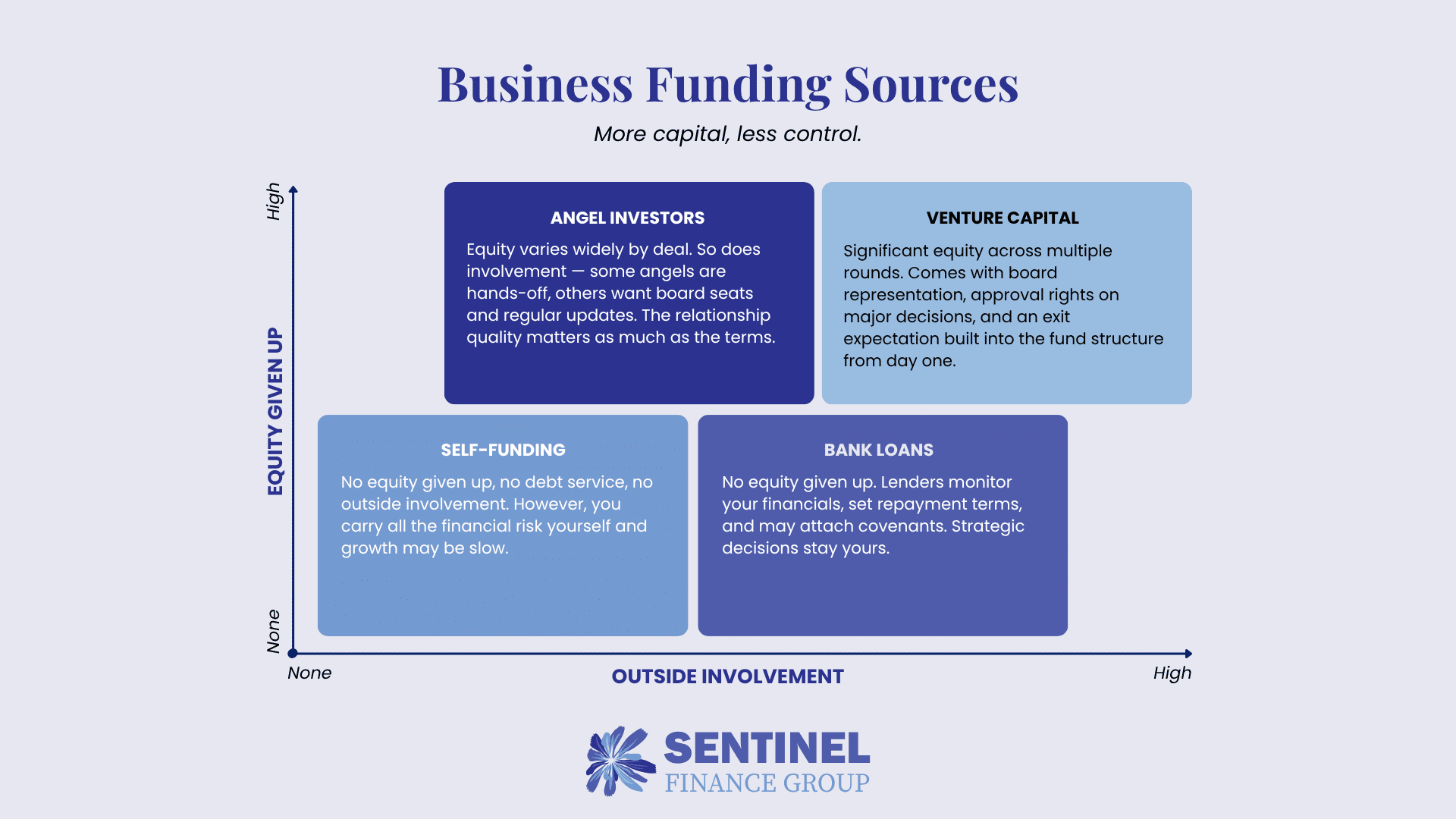
There are four main funding sources most businesses work with: bank loans, venture capital, angel investors, and self-funding. Each one has pros and cons. Knowing what you are giving up is just as important as knowing what you are getting.
The four main business funding sources:
- Bank loans: You repay with interest. No equity given up. Banks approve based on current cash flow and collateral, not future potential.
- Venture capital: You give up equity and a degree of control. VCs expect a future exit. Best for high-growth businesses that fit a specific investor profile.
- Angel investors: Private individuals investing their own money. Equity and involvement vary widely by deal. The relationship often matters more than the terms.
- Self-funding: You keep all your equity and carry all the risk. No debt service, no outside voice. Strongest option when your model does not require heavy upfront capital.
Bank Loans: You Keep Your Equity, but Must Prove You Can Repay Now
Banks are the most common funding source, and also the most straightforward. You borrow money. You pay it back with interest. You keep your equity.
Banks are risk-averse by design. They want to know you can service the debt right now, not that you could in the future if things go well. I have been in a lot of these meetings with clients, and what lenders are focused on is cash flow and collateral. They look at your debt-to-equity ratio, your current profitability, and whether you have assets to back the loan.
If you are profitable and have collateral, a bank loan is usually your cheapest source of capital because you give up nothing but interest.
SBA loans are worth knowing about here. The SBA 7(a) program has the agency partially guarantee the loan, which allows banks to extend better terms to businesses that might not otherwise qualify conventionally. The SBA tightened its underwriting standards significantly in 2025, raising minimum credit score thresholds and reinstating collateral requirements. The bar is higher now than it was a few years ago, but for well-qualified businesses, it remains one of the best non-dilutive funding options available.
The downside of bank debt is straightforward: you repay it on schedule regardless of how business is going. And banks do not advise you. The money comes without a strategic relationship.
Venture Capital: Institutional Capital in Exchange for Equity and an Exit Timeline
Venture capital firms provide capital in exchange for equity. They typically target high-growth businesses with specific industry and revenue profiles. In exchange for funding, VCs receive partial ownership, a voice in business decisions, and an expectation of a future exit. That exit expectation is built into the fund structure. It is not negotiable.
Most VCs have a defined target profile they stick to, including industry, revenue stage, and sometimes geography. If you do not fit, they pass. If you do fit, you are taking on a partner whose financial incentives may not always align with yours over the long run.
The upside is real. Good VCs bring strategic connections, credibility, and guidance that can accelerate growth in ways that are hard to replicate otherwise. But the institutional nature of the relationship is something founders need to understand going in.
Angel Investors: Private Capital With Variable Terms and High-Value Relationships
Angel investors are private individuals investing their own capital. They are less formal than VCs and their terms vary widely. Some are completely hands-off. Others want board representation and regular reporting.
Watch Shark Tank for a few minutes and you will notice something: the investors are frequently acquiring significant percentages of a business for what is a relatively small check. One Shark might offer $250,000 for 25% of a company. The founders who understand the dynamic know the money is almost secondary. The real value is the platform, the distribution, and the mentorship that investor’s name unlocks.
That is not just a television phenomenon. Angel investing at its best works the same way. The right angel brings connections and guidance that change the trajectory of a business. I have seen those relationships turn into genuine mentorships that made a real difference in how companies grew.
I have also seen them turn into the source of ongoing conflict. Disagreements over strategy, direction, and timing once the money is in the business. It can get difficult quickly. The difference almost always came down to whether the founder vetted the relationship before taking the money.
Because angels are individuals rather than funds, they can be more flexible on terms and more patient on timelines. They are most common at the early stages, before a business has enough of a track record to attract bank financing or institutional investors. That early access to capital can be the difference between getting started and staying stuck.
Self-Funding: The Underrated Option for Keeping Your Equity Intact
Self-funding does not get the attention it deserves, partly because it is not a dramatic story. You put in your own money and go to work.
But self-funding is how a lot of strong businesses get built. It is especially worth considering when you are getting started and want to keep most of your equity and wealth intact. The advantages are simple: you own the whole company, and you have no debt service. You build on your terms.
However, you are putting personal capital at risk. And if you are too conservative with deployment, you can miss growth windows that a funded competitor will take advantage of. Self-funding works best in business models that do not require heavy upfront capital investment to generate revenue, which includes service businesses, professional services, and many B2B models.
What I would add from experience: self-funding does not mean limited forever. It often means building toward a stronger negotiating position. Businesses that bootstrap to profitability almost always get better loan terms and attract better investors than businesses that raise early on potential alone.
Grants: A Supplement, Not a Strategy
Grants are non-dilutive and non-repayable, which sounds like the best option of all. In practice, grants are competitive, narrowly scoped, and rarely large enough to drive meaningful growth. They can be a useful boost for small businesses and nonprofits, but they are not a reliable primary funding source.
How to Protect Your Equity While Raising Capital
If you are considering outside funding, a few principles are worth internalizing before you sign anything.
Timing matters more than most people realize. The earlier you raise, the more equity you give away, because your valuation is lower and the investor is taking on more risk. Founders who bootstrap long enough to show real traction almost always negotiate better terms. If you can generate some proof before you raise, do it.
The investor relationship matters as much as the check. Equity is a partnership. That partner has rights. They get financial statements. Depending on how the deal is structured, they may have veto power over major decisions. Before you sell any equity, make sure your values and long-term goals are genuinely aligned with that person or firm. Look at how they have treated other founders they have worked with.
Do the ROI math. Do not evaluate an equity deal only on what the check enables today. Model what that investor’s stake will represent in 5, 10, and 20 years if your business keeps growing. A small percentage today can become a very large absolute payout later. The question is whether the benefit of the capital exceeds what you will pay out over the life of that equity relationship.
We work with clients on this analysis regularly. Before any major funding decision, we run the projections, test the assumptions, and make sure the terms hold up over the long game.
Finally, protect the majority. Once you have sold more than 50% of your equity, you are a minority owner. This should be a deliberate choice, not something that happens gradually across a few undisciplined rounds.
The Right Funding Source Depends on Your Situation
There is no universally correct answer. It depends on your stage, your industry, your growth objectives, and how much of the company you want to own five years from now.
What holds across every source: the benefit of outside capital needs to substantially exceed what you give up to get it. For debt, your future profit needs to justify the interest and repayment schedule. For equity, the growth that capital enables needs to outpace the future payouts you have committed to.
If you are working through a funding decision and want a second set of eyes on the financial modeling, that is exactly what we do at Sentinel Finance Group.
Schedule a conversation with Sentinel Finance Group.
Eric Reinacher is a fractional CFO who brings over a decade of financial leadership experience working with growing companies. He helps business owners improve financial visibility, make better decisions with their numbers, and build businesses that increase in value. LinkedIn
Sentinel Finance Group is a Kansas City-based fractional CFO and controller firm serving growing businesses across the US.