
Many business owners use revenue as their primary measure of progress. It’s visible, easy to track, and often tied to growth goals. But revenue alone doesn’t show whether the business is becoming more valuable.
Revenue is an input, not an output. It reflects how much money is coming into the business—not how much is being retained, how efficiently the business operates, or how much long-term business value is being created.
Why Revenue Can Be Misleading
Consider two businesses generating $2 million annually:
One operates with $1.9 million in expenses and produces $100,000 in profit.
The other operates more efficiently, with $1.2 million in expenses, and generates $800,000 in profit.
While the revenue is identical, the underlying performance and resulting value are very different.
This is a common issue. Revenue growth is often prioritized, while margins and cost structure receive less attention. Over time, that imbalance can lead to a business that is larger, but not necessarily more valuable.
To understand and build real value, it’s important to look beyond revenue and focus on how the business converts revenue into profit and long-term equity.
Profit: What Buyers Actually Pay For
In the world of business sales, valuation is typically tied to a profitability metric — most commonly EBITDA (Earnings Before Interest, Taxes, Depreciation, and Amortization). Buyers then apply a “multiple” to this number based on industry, growth, and risk.
Two businesses at the same revenue but different margins carry vastly different valuations. A business doing $2M in revenue at a 25% EBITDA margin ($500K) valued at 5x is worth $2.5 million. A business earning the same revenue but with 8% EBITDA ($160K) is worth just $800K. That’s a $1.7 million difference in enterprise value.
Equity: Financial Stability and Structural Net Worth
Equity (assets minus liabilities) represents the long-term, structural net worth of the business. While profit and cash flow are the primary drivers of valuation, equity is what tells you how financially sound the business actually is beneath the surface.
A business can be profitable and still be in a fragile position if it’s carrying too much debt, has weak working capital, or has allowed its balance sheet to deteriorate. Equity health matters because it signals whether the business can weather downturns, fund its own growth, and meet its obligations without relying on outside capital at unfavorable terms.
For most valuation purposes, equity value is used to assess financial stability. Key things a strong equity position communicates:
Balance Sheet Strength. A healthy ratio of assets to liabilities indicates the business isn’t overleveraged and has a cushion against operational shocks.
Working Capital Adequacy. Sufficient current assets relative to current liabilities means the business can fund its day-to-day operations without constantly tapping credit lines.
Retained Earnings. Accumulated retained earnings signal that the business has historically generated profit and reinvested it — a sign of discipline and long-term thinking.
Debt Structure. How the business is capitalized matters. High-interest short-term debt against depreciating assets looks very different from long-term, low-cost debt against productive ones.
In short: EBITDA and cash flow tell a buyer what the business earns. Equity tells them what the business is built on. Both matter when selling your business.
Three Levers to Build Value
When we work with clients on building business value, we focus on three levers beyond simply growing revenue:
1. Increase Profitable Revenue. Not all revenue is equal. Revenue that comes with thin margins, high churn, or difficult clients dilutes value even as it inflates the top line. The goal is revenue that is high-margin, sticky, and scalable. That might mean walking away from certain customers or engagements — a counterintuitive but often high-ROI move.
2. Improve Margin Efficiency. There is often value to unlock on the cost side of the ledger. Pricing optimization, vendor renegotiation, operational automation, and labor efficiency can move EBITDA margin meaningfully without adding a single dollar of new revenue — and each point of margin improvement compounds directly into higher valuation at exit.
3. Reduce Risk and Build Transferability. Every element of owner dependency, customer concentration, or undocumented process is a discount on your equity value. Systematically de-risking the business — through contracts, diversification, leadership development, and clean financial reporting — raises the multiple buyers and investors are willing to pay.
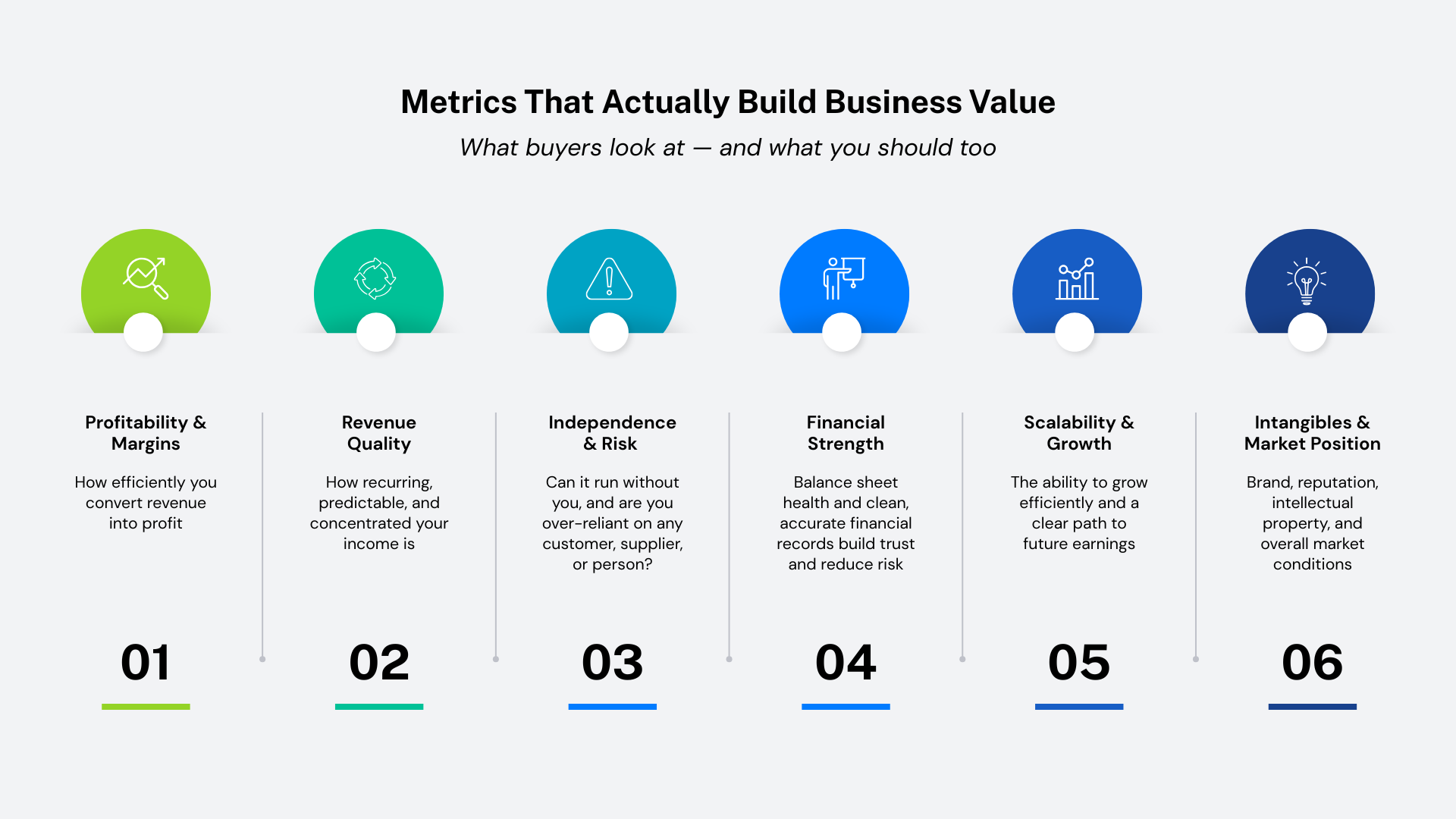
Metrics that Matter
If you want to understand and grow your business value, track these key areas:
-
- Profitability and Margins — EBITDA, EBITDA margin, and gross profit margin all point to how efficiently your business converts revenue into profit, which is the foundation of valuation
-
- Revenue Quality and Predictability — recurring revenue, customer retention, and customer concentration determine how stable and reliable your future revenue is
-
- Operational Independence — owner dependency and management depth indicate whether the business can run without you, which directly impacts value
-
- Financial Strength and Visibility — balance sheet health and clean, accurate financial records build trust and reduce risk for buyers or investors
-
- Scalability and Growth Potential — the ability to grow efficiently and a clear path to future earnings will increase what someone is willing to pay
-
- Risk Profile — reliance on key customers, suppliers, or individuals can reduce value if not addressed
-
- Intangible Assets and Market Position — brand, reputation, intellectual property, and overall market conditions all influence how your business is perceived and valued
Revenue belongs on this list too — but as one signal among many. The most valuable businesses aren’t always the biggest. Value is built on profit, structure, and sustainability.
The most successful business owners don’t just focus on growth at any cost. They focus on building something that’s actually worth buying.
Sentinel Finance Group brings decades of experience providing fractional CFO and controller services to small and mid-sized businesses and has extensive expertise in real estate, construction, and logistics.